

Cybersecurity Governance Board-Level Oversight
Cybersecurity Governance Board-Level Oversight
Boards are now expected to demonstrate active oversight of cyber risk, not passive reliance on management reporting. Regulatory scrutiny, privacy obligations, supply chain exposure, and ransomware disruption have elevated cybersecurity into a governance, compliance, and business continuity issue. This requires structured reporting, defined accountability, risk-based investment decisions, and board literacy in cyber risk.
Directors are expected to interrogate cyber risk exposure, align cybersecurity strategy with business objectives, and ensure accountability across executive leadership. In a regulatory environment shaped by evolving privacy obligations and increasing scrutiny from regulators and investors, cybersecurity governance is a board-level responsibility.

Governance Governance
As cybersecurity governance has moved beyond operational IT management into the core of corporate strategy, enterprise risk management, and regulatory compliance, it is no longer a siloed IT function. Across Australia and globally, cyber risk is now embedded in corporate governance, enterprise risk management, and digital transformation strategy.
For cyber professionals, CISOs, security architects, risk managers, and cyber strategy professionals, engagement with the board requires clear articulation of threat intelligence, risk scenarios, cyber maturity uplift plans, and incident response capability. The discussion below frames cybersecurity as a governance issue and outlines practical actions boards can take to strengthen oversight and enterprise resilience.
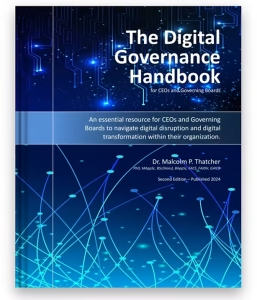
The article below, by Dr Malcolm Thatcher, directly addresses governance in the boardroom. The article is republished below with permission from the author. Dr Thatcher frames governance as a core board-level responsibility that directly affects strategy, risk and stakeholder trust.
Republished Article
Author: Dr. Malcolm Thatcher
This article is republished with permission. The author has indicated it is available for public reuse.
Why Cybersecurity Belongs in the Boardroom
Cyber incidents routinely disrupt operations, trigger regulatory scrutiny, erode stakeholder trust, and destroy enterprise value, which places them squarely within the board’s fiduciary and oversight responsibilities. Regulatory expectations and investor scrutiny have also shifted, with boards increasingly expected to demonstrate active governance of cyber risk, not simply reliance on management assurances[1].
Understand the Threat Landscape
Effective oversight starts with an understanding of the threat landscape facing the organisation’s sector, geography, and business model. Ransomware, supply-chain compromise, business email compromise, insider threats, and attacks on cloud and operational technology environments all present different implications for disruption and recovery.
Boards should expect periodic briefings on emerging threats, significant incidents affecting peers, and how these developments translate into concrete risk scenarios for their own organisation[2].

What Can Boards Do?
Boards can strengthen cyber-risk governance by focusing on a small number of high-impact actions:
Develop Cybersecurity Literacy: Board members need to understand (not just acknowledge) the key cybersecurity risks facing the organisation.
Oversee Cybersecurity Strategy: Actively participate in the development and oversight of the organisation’s cybersecurity strategy. See below for further discussion.
Ensure Adequate Resources: Allocate sufficient resources for cybersecurity investments, including personnel, technology, and training. Boards should test whether cybersecurity budgets are grounded in risk and business impact, rather than historic IT percentages or ad hoc responses to incidents[1].
Establish and Test Incident Response: Boards must assume the organisation will experience a significant cyber incident and govern accordingly, insisting on a documented, regularly tested incident response plan covering technical, operational, legal, regulatory, communications, and stakeholder aspects. Directors should participate in or observe simulations to understand escalation paths, decision rights, and the realistic time needed to restore critical services.
Conduct Regular Risk Assessments: Regular assessments of cybersecurity risks, policies, processes, and controls—undertaken by independent internal functions and external experts—help identify vulnerabilities, validate management’s self-assessment, and prioritise remediation[2].
Foster a Culture of Cybersecurity: Promote a culture of information and cyber security awareness among all employees.

Boards Must Oversee Cybersecurity Strategy
Establishing and overseeing a Cybersecurity Strategy is a key board responsibility in this era of persistent and relentless cyber threats.
A dedicated cyber strategy addresses specific requirements of information security within your organisation and should provide a roadmap of activity to improve your cybersecurity defences, responses and overall cyber capability. Like an IT / Digital Strategy, a Cybersecurity Strategy should be aspirational and be a mechanism that helps drive organisational culture[3].
A cybersecurity strategy must be tightly aligned with business objectives, digital transformation priorities, and the organisation’s overall risk appetite. Boards should ensure that cyber risk is integrated into enterprise risk management, strategic planning, and major investment decisions, rather than treated as a parallel technical stream[1].
At a governance level, boards should clarify cybersecurity accountability and how cybersecurity matters are to be reported to the board. Directors should challenge management on how cybersecurity enables business resilience and competitive differentiation, not just compliance with minimum standards[4].
There is no shortage of cybersecurity standards and guidelines for boards to consider in formulating a cybersecurity strategy. These provide the basis of information security and privacy principles and obligations. My recommendation for the structure of a cybersecurity strategy is as follows:

Introduction
- Clarify the objectives of the strategy and its intended audience, including the board, executive, and key stakeholders.
- Provide organisational context – its history and purpose with a focus on the information entrusted to the organisation.
Cyber Threat Trends
- Summarise global / regional / local threat trends, including an overview of cyber risks to the organisation based on the current cyber threat landscape.
- Highlight the importance of having access to quality, up-to-date threat intelligence specific to the sector that the organisation operates in.
Information Security & Privacy Principles & Obligations
- Describe the information privacy and security principles that are important to your organization. Examples include data minimization, data integrity, least privilege & access control, accountability and transparency, and information privacy and security by design.
- Identify key statutory and regulatory obligations, including sector-specific and any cross-border requirements, and explain how the organisation will ensure compliance in practice.
Cyber Security Governance
- Describe how cybersecurity governance integrates with existing corporate governance structures, board committees, and executive forums.
- Define roles and responsibilities for managing cyber risk, including the CISO (or equivalent), other executives, internal audit, and external advisers, and outline internal and external assurance mechanisms.
Cyber Threat Defences
- Provide an overview of the current technology assets within the organization, broadly grouped into devices, networks, hardware infrastructure and software systems.
- Describe the target state for cyber defences for each of the above asset groups, aligned to an appropriate framework or standard.
- Set priorities for improving the cyber security maturity of the technology and information assets including any dependencies.
Threat Intelligence
- Affirm the importance of having access to quality, actionable, up-to-date threat intelligence specific to the sector that the organization operates in.
- Explain how security-related data from different sources will be collected, analysed, correlated, and used to identify patterns, detect anomalies, and support proactive responses.
Cyber Incident Response
- Outline the organisation’s approach to incident detection, escalation, response, and recovery, including decision-making thresholds and communication protocols.
- Describe major incident scenarios (for example, ransomware, third-party compromise, or loss of critical systems) and the key considerations, actions, and trade-offs the organisation is prepared to make.
Cyber Security Awareness and Training
- Explain how the organisation will build and sustain a culture of cyber and information security awareness and vigilance across all levels.
- Describe the training program, including online modules, phishing simulations, targeted training for high-risk roles, and periodic major incident exercises.
Investment Plan
- Summarise the resources required to deliver the strategy over an agreed timeframe, including technology, people, and external expertise.
- Group key initiatives under themes such as governance, threat defences, threat intelligence, incident response, and awareness and training, and outline the expected benefits for the organisation and its stakeholders.

Putting Cyber Governance into Practice
For many boards, the key shift is moving from viewing cybersecurity as a technical problem to treating it as a strategic, enterprise-wide governance issue that the board owns and steers. A practical starting point is to benchmark current practices against leading cyber-governance frameworks, identify gaps in literacy, oversight, and resourcing, and then adopt a staged roadmap to uplift board and organisational capability[5].
Ultimately, cyber-resilient organisations are characterised by boards that interrogate the threat landscape, help shape strategy, resource appropriately, and champion a culture in which every employee understands their role in protecting the organisation’s information and systems. In a digital economy where disruption is inevitable, this level of governance is integral to protecting stakeholder value and sustaining long-term trust[6].
[1] https://sloanreview.mit.edu/article/the-boards-role-in-managing-cybersecurity-risks/
[2] https://corpgov.law.harvard.edu/2021/06/10/principles-for-board-governance-of-cyber-risk/
[4] https://www.bitsgroup.com.au/knowledgebase/cyber-security-for-directors-and-boards/
Follow us UBIS Cybersecurity Jobs Platform Across Australia
UBIS Cybersecurity Jobs
www.ubis.com.au